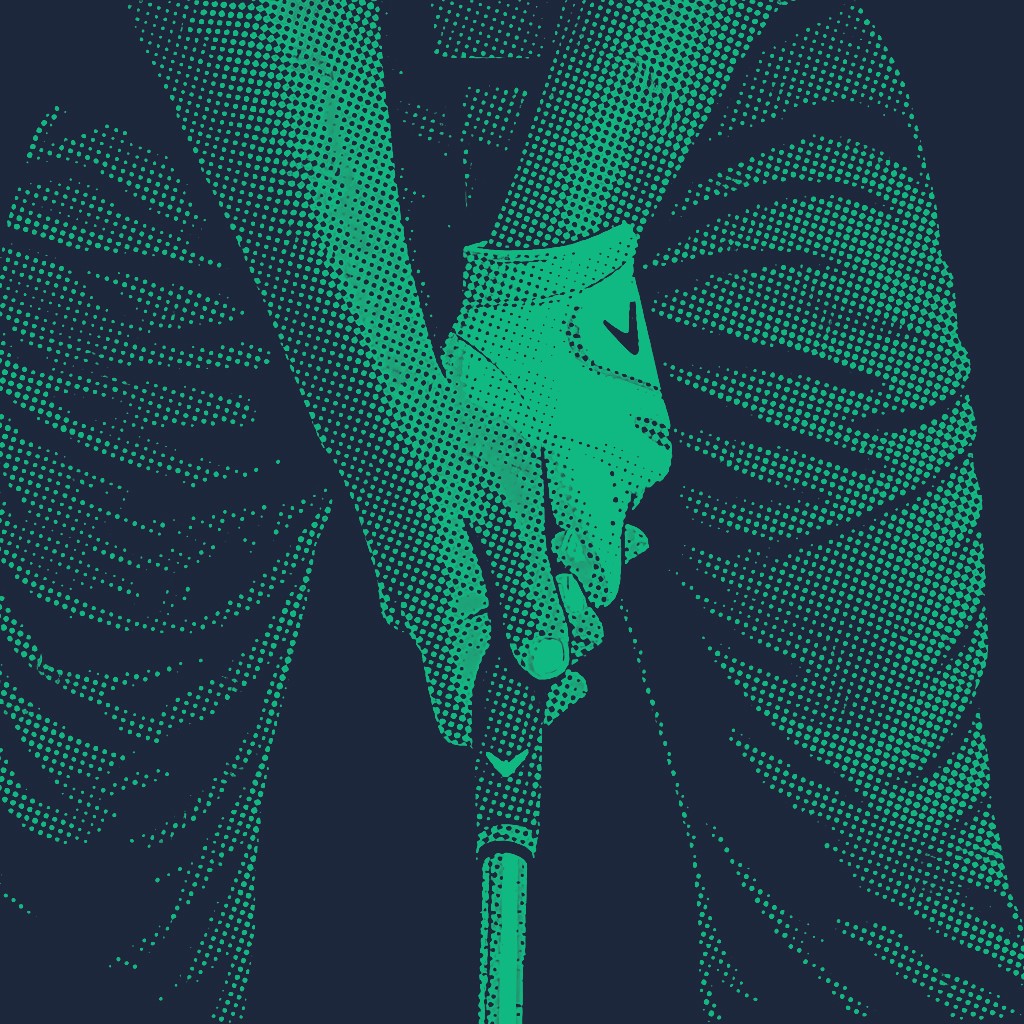
Your grip is ruining your life (or at least your Saturday)
The Birdie Lab Guide to Not Strangling Your Clubs (and Your Scorecard).
Let’s be honest: you’ve spent three months watching YouTube videos on "shallowly clearing your hips" while your hands are holding that club like a frantic squirrel clinging to a bird feeder. If your connection to the tool is broken, the rest of the swing is just expensive interpretive dance.
At Birdie Lab, we see the data. We know when your "consistency" looks like a Jackson Pollock painting. Usually, it starts right here—with your hands. Here are five ways you’re choking the life out of your game.
1. The "Death Grip": Stop strangling the bird
You’ve heard the cliché: hold the club like a tube of toothpaste or a small bird. Instead, you’re holding it like a guy who’s about to fall off a cliff.
Why it’s killing you: Squeezing too hard creates tension that travels up your forearms, into your elbows, and locks your shoulders. Tension is the sworn enemy of speed. If you want that "pro" effortless power, you have to stop trying to crush the graphite.
The Fix: On a scale of 1 to 10, aim for a 4. Firm enough that the club doesn't fly into the lake, soft enough that you don't look like you're winning an arm-wrestling match.
2. The "Palm" Position: You aren't holding a suitcase
A common mistake in the how to swing a golf club rabbit hole is placing the handle across the lifeline of your palm.
Why it’s killing you: When the club sits in your palm, you lose your ability to hinge your wrists. No hinge = no leverage = no distance. You’ll end up with a stiff, "wooden" swing that produces weak fades and a lot of frustration.
The Fix: Run the grip through your fingers, not your palm. You should feel the pad of your lead hand sitting on top of the grip, not wrapped around the side of it.
3. Long Thumb vs. Short Thumb: Size matters
How you extend your lead thumb along the shaft changes everything about your support at the top of the swing.
Why it’s killing you: A "Long Thumb" (extended far down the shaft) might feel stable, but it often leads to regripping at the top because the club slides around. A "Short Thumb" (pulled back toward the hand) provides a much more compact, controlled support structure.
The Fix: Snug that thumb back slightly. It creates a "cradle" for the club to sit in at the top of your backswing, so you aren't playing catch with your driver at 100 mph.
4. Disconnected Hands: This isn't a high-five
Whether you use Interlocking, Overlapping, or (god forbid) the Baseball grip, your hands must act as one single unit.
Why it’s killing you: If there’s a gap between your hands, they will fight each other. One hand tries to pull, the other tries to push, and the clubface ends up doing whatever it wants. Disconnected hands are the fast track to a "flip" at impact and inconsistent strikes.
The Fix: Make sure the pinky of your trailing hand is nestled snugly against (or inside) the index finger of your lead hand. No gaps. No daylight. One team, one dream.
5. The "Drop Test"
If you aren't sure if your pressure is right, try the Birdie Lab Drop Test.
Address the ball, take your grip, and have a friend (or a patient spouse) try to pull the club out of your hands. If they can’t move it, you’re too tight. If they pull it out and you fall over, you’re too loose. You want enough friction that the club stays put, but enough "oil" in the joints that your wrists can snap like a whip.
STOP GUESSING. START KNOWING.
Your grip might be the "why," but the "what" is in the data. Birdie Lab tracks your miss patterns and consistency to show you exactly where your game is leaking oil—and it’s 100% free.